
Iraq Invites America's Banks
Al-Zaidi asked America's banks into Iraq. A US airport post in Baghdad was handed back. Import dollars now need customs paid first. CNN's sale is cleared.
Friday, September 25. Inside his country's Permanent Mission to the United Nations in New York, Prime Minister Ali al-Zaidi sat down with a table of American banks and financial institutions. He told them why Baghdad's banks have been weak. In part, his office wrote, it was isolation: too little openness to the international banking world, and to American banks above all. Then he asked them in.
Back in Baghdad the same day, the two governments signed the US Embassy's Diplomatic Support Center at the capital's airport over to the Iraqi state, one of the last steps before the coalition's mission ends on September 30. One side of the relationship is handing back an American post. The other is being invited to open accounts.
Around those two moves, the CBI told every bank in the country that import money now leaves only after customs is paid. A currency gang in Baghdad was charged. And in Washington, the news operation that shaped a decade of war coverage is getting new owners, possibly with Elon Musk among them. Today we take the news in that order.
Reset Intelligence / Research Desk
Your deep research analyst.
Put any question on the IQD, the RV or the reset to the RI research assistant. It answers in seconds and will conduct deep research to find you the answer.
Try the Research AssistantThe Invitation
Let's start with what the Prime Minister's office actually published, because it goes further than the headline. Per its readout, al-Zaidi hosted representatives of a group of American banks and financial institutions, with economic officials and Iraqi bankers in the room. He described a new stage of economic transformation and financial and banking reform.
Then came the diagnosis, in his office's own words. The weakness of Iraq's banks over the past years was tied, in part, to limited openness and connection to the international banking system, especially American banks. Their entry into the Iraqi market, he said, would be a qualitative leap for the sector. He put numbers beside the pitch: output of about 4.5 million barrels a day now, and a policy to lift it toward 10 million, the target we laid out in 6 Million Barrels a Day. A full reform plan for the state banks is underway, he added, and the anti-corruption drive is moving in the right direction.
Read what that assumes. Correspondent banks are the links a currency travels through abroad. Every dollar an Iraqi bank sends or receives crosses one. In July, seven Iraqi banks were cleared to reconnect for business in euros, dirhams and yuan, with dollar business left for a later phase, as we covered in Washington Puts a Price on Dollar Access. The American bank that has sat inside Iraq's trade finance since 2003 is the thread 23 Years in Baghdad pulled on.
The new part is who is doing the asking. For 2 years Washington told Baghdad what to fix before its banks could reconnect. This week Baghdad's head of government told American lenders the reform is far enough along to come and look. No bank names were published.
Community channels read the meeting hard. No American bank, the argument runs, wires dollars into Baghdad to trade at 1,310, so bank entry forces the rate to adjust. That is their read, not the Prime Minister's, and nobody at the table said it. What the table did say is plain enough: the relationship Iraq wants next runs through American lenders.
Import Money Now Clears Through Customs
The CBI's banking supervision department sent every licensed bank a circular this week, carrying out cabinet Decision 413 of 2026. Before an Iraqi bank releases money abroad to pay for imports, the importer now has to produce a preliminary customs declaration. Duties and tax deposits are collected in advance through ASYCUDA, the electronic customs system. The declaration number rides inside the transfer data, electronically linked to the bank's transfer system. Banks must obtain SWIFT verification codes before the declaration is endorsed, refunds run electronically, and public awareness campaigns come before enforcement.
Why this lands where it does. For 20 years the fake import invoice was the leak: dollars bought at the official rate against goods that never arrived, then carried out through the money changers, the machine we took apart in ASYCUDA Enforcement Day. Customs began checking invoices at every crossing this summer. Prepaid duties start October 1, as we flagged in Missiles and Manifests. This circular closes the loop from the bank's side. No duty paid. No transfer. One record for the paperwork and the money.
Community channels read the circular as a cutover of every foreign transfer on October 1. It is narrower than that. It covers the money Iraq sends out to pay for goods, and that is exactly where the dollars used to walk out of the country.
The enforcement side had its week too. On Wednesday, Iraq's Federal Intelligence and Investigations Agency dismantled an unlicensed exchange network in Baghdad's Rusafa district. Five people were arrested and $240,000 seized, charged under Article 57 of the Banking Law for running exchange and transfers through social media. The street moved the right way the same day. A hundred dollars closed Wednesday at 156,750 dinars in Baghdad, down from the 160,000 it touched last week, while the official rate holds at 131,000.
The Airport Handover
On Thursday, US Chargé d'Affaires Steven Fagin and Deputy Foreign Minister Mohammed Hussein Bahr al-Uloom signed the agreement. The embassy's Diplomatic Support Center at Baghdad International Airport now belongs to the Iraqi government. Iraq's foreign ministry framed it as part of completing the procedures to end the international coalition's presence by September 30. With that site handed over, the coalition's remaining footprint sits at Erbil airport.
That is the date we built No Extension around, and Turkey agreed its staged Bashiqa handover the day before. Now look at the order inside a single day. A security post at the airport, handed back. A prime minister in New York, asking American lenders in. An import payment, cleared only against a customs code. It runs in reverse of 2003, when the soldiers arrived first and a new state trade bank was set up behind them under occupation authority.
The Budget's First Signature
Per a single source speaking to an Iraqi news platform, the Kurdistan Region's finance ministry and its federal counterpart have reached an understanding on the 2027 budget. It covers the region's share and how its oil and non-oil revenue are handled, with solutions for most outstanding issues. The final signature waits on Finance Minister Faleh al-Sari's return from the United States. One source. No published document. We hold it loosely.
Erbil's asks are already on record: 29 trillion dinars, a share of roughly 14.1% of the federal budget, plus 450 billion dinars to equalize Peshmerga salaries. Baghdad has printed October 15 as the date the draft goes to parliament.
Why it matters: the split between Baghdad and Erbil sits at the center of every failed Iraqi oil law since 2007. If a finance minister's signature settles it inside the budget, the bill that must eventually record the dinar's value reaches parliament without its oldest argument attached. The value itself remains the CBI's to set.
Tehran's Countdown
Mohsen Rezaei, Iran's top security official, has given Washington 4 to 5 days to accept Tehran's conditions, in full and all at once. The public ones: an end to the fighting on every front, the naval blockade lifted, the economic pressure ended, frozen assets released and the strait reopened. Hormuz, he said, stays closed as the guarantee they are met. His deadline runs out in the last days before Iraq's September 30.
Then the president changed the calendar. Masoud Pezeshkian told American television on Thursday, "We don't want it to get to the midterm elections," and called for a return to the memorandum before them. That answers Trump, who said this week he expected Iran to settle once the November vote was behind him. The man who told the General Assembly Iran would not bend the knee is now arguing about which month to sign in.
The trade on the table now has a shape. A senior Iranian official told wire reporters the most realistic path is for Tehran to allow navigation through Hormuz in exchange for Washington ending the naval blockade. The traffic numbers do not agree with each other yet. A US official says about 60 ships crossed the strait on Wednesday, some 40 of them coordinated with the US military. Ship-tracking data counted just 10 commodity vessels the same day, below the 10-day average of 17. We print both counts because neither has been reconciled. Brent closed Thursday at $106.60, up 3.4% on the day.
Inside Iran, Brigadier General Hossein Zarifi, who ran a Revolutionary Guard base in Saravan in the southeast, was killed in a raid on an armed cell Tehran called enemy-backed. The Guard says five militants died in the same clash.
The Last Layer
Head of the Snake maps the network that fed on the region's money in six load-bearing layers: the banks, the weapons contractors, the proxy networks, the regime's own nodes, the protected political class, and the media. In May, in The Strike Before the Signatures, we wrote of the last one: "The media. The narrative arm. The last layer still operating. Watch how they evolve in the coming months."
On Monday, Paramount settled the antitrust case against its takeover of Warner Bros. Discovery, clearing the way for David Ellison's company to own CNN alongside CBS. Per a financial news exclusive, Paramount executives have now discussed asking Elon Musk to join a syndicate of equity investors. Larry Ellison, David's father and a long-time Musk ally, has personally guaranteed more than $40 billion of the takeover's equity financing. No agreement announced, no amount reported, nothing filed. If it happens, the man who bought Twitter would hold a piece of CNN and CBS. He was also on the guest list for Thursday's White House state dinner for Xi Jinping. That is speculation today, and it will be interesting if it becomes paperwork.
The staff are not waiting to find out. Kara Swisher has asked her agent to get her out of her CNN contract, which runs to December 31, rather than work for the Ellisons.
The fight over the briefing room ran in parallel. Last week Trump barred CNN and two other outlets, the ban we logged in The Precipice, and the administration launched its own 24-hour stream, as we covered in The Summit. On Thursday a federal judge, Timothy Kelly, ordered the three outlets' access restored for at least 14 days, ruling their passes were pulled without due process. Their reporters were turned away at the gate that morning before being let back in, and Trump says the administration will appeal.
Hold both halves. The White House says it wants what reaches the public to be accurate, and it is willing to fight in court over who sits in its room. The court says it must follow procedure to get there. What is not in dispute is the direction. The layer that told the public what this war meant for a decade is changing owners, losing staff and fighting for its seats, all in public.
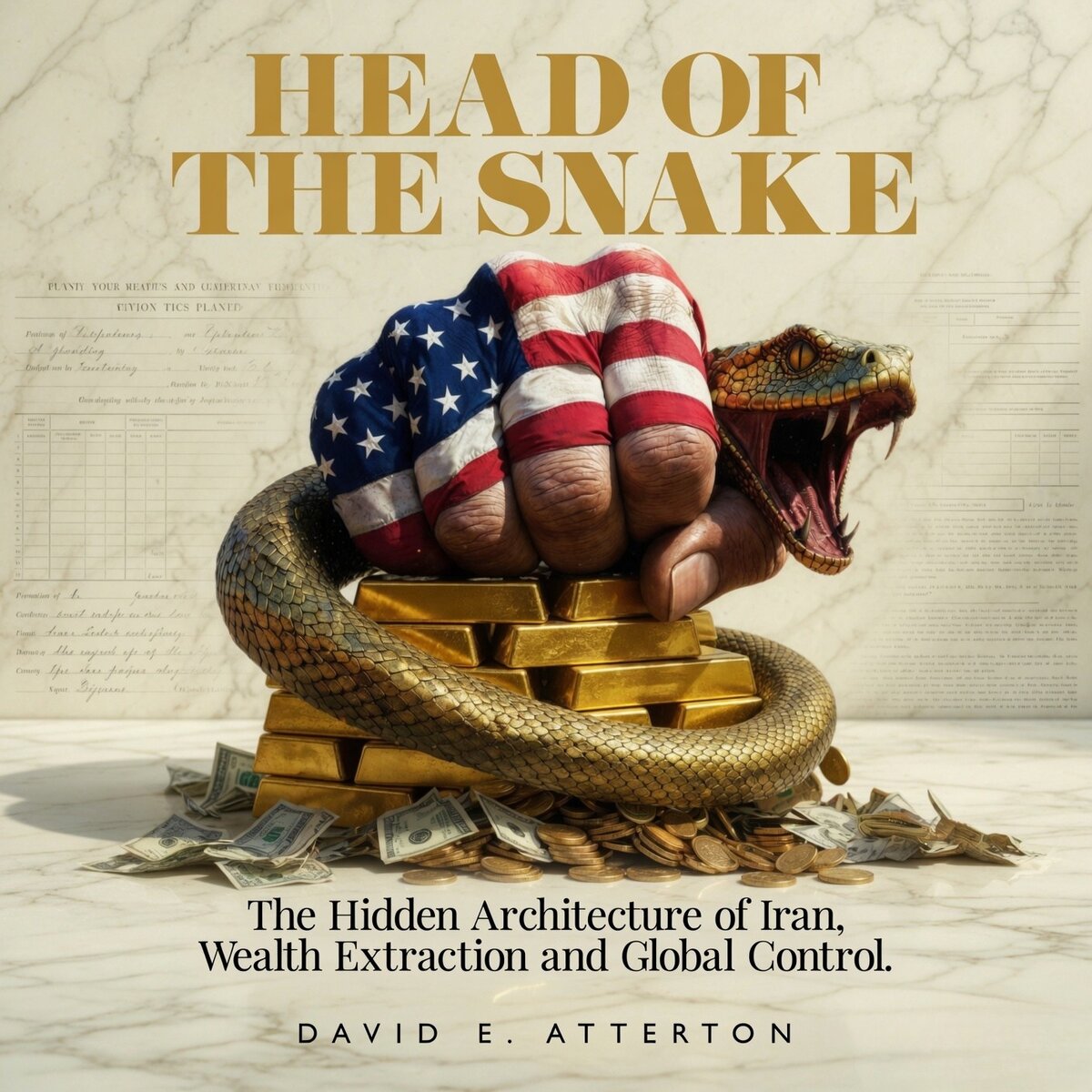
The book behind the briefing
Head of the Snake
★★★★★ Over 500 downloads
The Hidden Architecture of Iran, Wealth Extraction and Global Control
The briefing is today's move. The book is the 118 years behind it - how the Federal Reserve, the petrodollar and Iraq's frozen dinar became one system of control, all documented from the public record. It saw the shape of this before the news did.
Get the BookXi at the White House
Xi Jinping's state visit reached its White House dinner on Thursday, his first visit to Washington in more than a decade. Xi called the talks candid and in-depth, said the two sides reached many new common understandings, and described the relationship as constructive strategic stability. His gift was diplomatic: two giant pandas bound for Zoo Atlanta.
What the visit did not produce is just as telling. No deal was announced on soybeans, aircraft, chips or Taiwan. The 2-month truce extension to January 10, which we reported yesterday, stands, along with an agreed channel for discussing AI safety incidents. Our read: a steady line between Washington and Beijing leaves Tehran's largest oil customer with less reason to spend capital keeping Iran afloat.
Rails and the Price of Money
On Thursday the Federal Reserve proposed two rules under the GENIUS Act. Stablecoins it oversees must be fully backed by Treasury bills and other high-quality liquid assets, with capital and risk standards on issuers. Fed-supervised banks that want to issue one must file a business plan and financials. Governor Michael Barr put the test in one line: "Stablecoins will only be stable if they can be reliably and promptly redeemed at par in a range of conditions." Comments close 60 days after publication. The Treasury's licensing rule arrived in August, as we covered in The Iran Endgame.
Across the Atlantic the same day, Lloyds, NatWest and Barclays completed the first interbank payments using tokenised deposits, including live remortgage settlements. UK industry plans three tokenised bonds in early 2027. And the CFTC now lets futures brokers and clearing houses hold customer funds in tokenised versions of assets they could already hold. These rules decide how money moves. They do not decide what any currency is worth.
Borrowing dollars kept getting dearer. On Thursday the US 10-year yield reached 5.11%, its highest since 2007, and the 30-year pushed past 5.44%. The dollar index rose near 101 after the strongest US business survey in over 5 years. Futures now price an October rate hike at roughly 64 to 70%. Gold gave ground on the same bets, to about $4,270, with silver near $63.
The Community's Read
Community channels spent the week on two claims. The first is that Iraq's government formation follows as soon as al-Zaidi lands this weekend, with the hiring lines in the 2027 budget read as preparation for it. The second is the October 1 cutover, which the circular above narrows to money paid out for imports. We carry both as their read until otherwise verified.
The Read
In 2003 the Americans came to Baghdad in uniform, and the banking arrived behind them, a state bank for Iraq's trade set up under occupation authority. This week the order ran backwards. An American diplomatic support post at Baghdad's airport was signed over to the Iraqi state, and on the same day the Prime Minister sat in New York with America's banks and invited them in on Iraq's terms.
That reversal is the week. A country moving foreign forces out of its capital while inviting foreign lenders into its banks is making one decision in two directions. Security becomes Iraq's job. Finance becomes a partnership it chose. Around that decision, the plumbing tightened. Import dollars now leave only with duties paid and a SWIFT code attached. A currency network in Rusafa was charged. And the fight at the center of every failed Iraqi oil law since 2007, how Baghdad and Erbil split the money, may be one ministerial signature from settled.
The same cleanup ran in Washington, at the layer our book calls the narrative arm. The news operation that defined this war for a decade is changing owners, the richest man on earth may take a stake, and the White House is in court over who gets a seat in its briefing room. You do not have to cheer every move to see the direction. The institutions that told the public what to think are being re-owned and re-seated in the open.
So what does it mean for you? The IQD gets its real value when the world's banks agree to clear it, and the world clears dollars through American lenders. For 2 decades those lenders treated Iraq as a compliance risk. This week Iraq's head of government asked them to treat it as a market, with the customs link, the arrests and the budget laid out beside the invitation.
The coalition's mission ends September 30. The banks Baghdad just invited decide whether the world clears the IQD.

Worth gifting
How to help the people closest to you
Put the intelligence in their hands. Gift a full membership, a month or a year on you, and they start reading in a click. Nothing for them to pay, nothing to set up.
Gift a subscriptionRecent analysis
- Iraq Drops the Borrowing Law
- Are Gold-Backed Currencies Coming?
- IQD: The Currency of the New Babylon
- Pensions for Weapons
- Iraq Enters the Final Stretch
Sources & References
- Al-Zaidi hosts American banks and financial institutions at Iraq's UN mission, 4.5 million barrels a day, state-bank reform - Iraqi PMO on X
- Al-Zaidi pitch to the US Chamber of Commerce - 964 Media
- CBI circular linking import transfers to ASYCUDA customs pre-payment and SWIFT codes - Al-Mustaqila | Iraq Business News
- Unlicensed exchange network dismantled in Rusafa, 5 arrested, $240,000 seized - Iraq Business News | Rudaw
- Dollar closes at 156,750 in Baghdad and Erbil - Shafaq News | Iraqi News
- US Embassy Diplomatic Support Center at Baghdad airport handed to Iraq - The New Region | Hatha Alyoum
- Baghdad and Erbil reach 2027 budget understanding, signature awaits Finance Minister - One News on X
- Kurdistan Region seeks 450 billion dinars for Peshmerga salaries, 14.14% share - Kurdistan24 | Channel8
- Rezaei 4 to 5 day deadline, Hormuz as guarantee - AVA Press | GlobalSecurity
- Pezeshkian wants a deal before the midterms - NBC News | The Hill
- About 60 ships through Hormuz on Wednesday, Hormuz-for-blockade talks - BOE Report / Reuters
- Brent crude - Fortune | Trading Economics
- IRGC commander killed in southeast Iran - The National
- Paramount weighs Musk as equity investor - Semafor | Variety | Deadline
- Kara Swisher leaving CNN after Paramount settlement - Deadline
- Judge restores CNN, MS NOW and Politico White House access - CNBC | Time
- Trump and Xi state dinner, pandas to Zoo Atlanta - Nick Sortor on X | Nick Sortor on X
- Trade truce extension and AI channel - CNBC
- Federal Reserve GENIUS Act stablecoin proposals - CoinDesk | Coin Bureau on X
- Iranian official on Hormuz-for-blockade path, 10 commodity vessels tracked Wednesday, Brent close - CNBC
- Musk on the Xi state dinner guest list - The Washington Post
- UK banks' first interbank tokenised deposit transactions - Euronews | RTE
- CFTC tokenised collateral guidance - Lowenstein Sandler
- 10-year yield highest since 2007 - CNBC | Trading Economics
- Dollar index and October hike odds - Trading Economics
- Gold and silver, September 24 - Fortune | Fortune
- Internal callbacks - 6 Million Barrels a Day | Washington Puts a Price on Dollar Access | 23 Years in Baghdad | ASYCUDA Enforcement Day | Missiles and Manifests | No Extension | The Strike Before the Signatures | The Precipice | The Summit | The Iran Endgame
- The Two Tracks - How Dinar Holders Actually Get Paid
- The Research Desk - Ask the RI Research Assistant - it answers in seconds and will conduct deep research to find you the answer.
- The Library - Free Resource Library
- Book - Head of the Snake
- Common questions about the Iraqi dinar - Is the Iraqi dinar revaluation real? | When will the Iraqi dinar revalue? | What will the Iraqi dinar revalue at? | Is the Iraqi dinar a scam? | Why is the Iraqi dinar valued so low? | Where can I safely buy Iraqi dinar? | How do I exchange Iraqi dinar after a revaluation? | Will I owe tax when my dinar revalues?
For simple answers to every common question, see the full Iraqi Dinar FAQ.