5 Days in Washington
A whole government in Washington for 5 days. Iraq is trading troops, oil and alliances to switch financial systems. A country changing sides, in broad daylight.
Tuesday July 14, and Ali al-Zaidi's government is into its first full day of talks in Washington. It did not fly here to shake one hand. Over 5 days the Iraqi delegation works 4 files in 4 rooms: the finance minister across the table from the World Bank, the IMF and the US Treasury; the oil minister carrying a fund that would park up to $400 billion of Iraqi oil money in American banks; the security chiefs at the Pentagon and with Republican and Democratic leaders in Congress; and, tomorrow, a central-bank order that lets Iraqi banks pay out dollars in cash while the governor who signed it stands on American soil.
Yesterday you watched the whole government board one plane, and we said the manifest was the message. This week the message turns into signatures. This is where the reading pays, and it is where we start.
Read the week as one move rather than five. Iraq is changing the system it belongs to, and it is paying the entry fee across every arm of the state at once. That is why the whole government came, not just the prime minister. Each room unlocks a different door, and the doors are wired together. The investment will not come without the security. The banks will not clear the money without the clean-up. All of it has to move in the same week, or none of it moves. Period.
The Coalition Sets Its Own Exit Date
Start with the file that has waited 20 years. Al-Zaidi says the US-led coalition's combat mission against ISIS ends in September. The foreign troops that have sat in Iraq for over a decade drop below 2,000 and fall back to Erbil. What is left turns into a plain relationship between two governments. Beside it he is pressing to disarm the Iran-backed militias that have run as a state inside the state, and he is carrying the whole package to both parties in Congress, not only the White House.
Understand what is ending. For over a decade an international coalition has operated on Iraqi soil, first to beat ISIS back, then as the tripwire that kept Iran's proxies honest. Al-Zaidi is setting the date for that chapter to close and folding what stays into a normal arrangement between two capitals. The militias are the catch. Disarming the armed groups that answer to Tehran is the promise Washington values most, and it is the one that puts a target on al-Zaidi's own back at home.
Read the choice of audience. You take a deal to both sides of the aisle when you want it to survive the next election. A one-term handshake is a photo. The bipartisan version is a treaty in all but name.
Mourning in Najaf, Strikes in Hormuz tracked the same hand a week ago, when al-Zaidi barred every Iraqi official from unsanctioned contact with Tehran while US jets worked the Iranian coast. A government that meant to stay in Iran's orbit does not evict foreign troops and Iranian guns in one summer. Baghdad is deciding who guards the house. It is not leaving the keys with Tehran. The choice is already made.
The Fund That Parks Iraqi Oil in an American Bank
Then the money that rides in with the oil. The American majors are being walked back into the fields. Chevron takes the big upstream blocks. ExxonMobil is behind it. HKN takes over the Hamrin oil field, and Excelerate is building Iraq's first LNG terminal, the one meant to replace the gas the country now buys from Iran. Baghdad is offering American operators the security guarantees in the north that kept them cautious for years. Underneath the deals sits the fund that surfaced late last month: 500,000 barrels a day to start, scaling toward 2 million, up to $400 billion over 30 years, with the proceeds held in US banks.
Hear that last part again. The money does not stay home. Iraq is not selling barrels at the door. It is posting its oil income inside the American system as proof it is good for the paper.
Here is why that unlocks the money. No American company sinks 30 years of investment into Iraqi power plants and pipelines on a promise. Pledge a steady stream of oil income into an account those companies can watch, and that guarantee is what lets the capital flow the other way.
That trade has a name, and it is worth the insight.
February 1945. On a warship anchored in Egypt's Great Bitter Lake, Franklin Roosevelt and Ibn Saud struck one bargain: American security for a steady supply of Saudi oil. It made a desert kingdom one of the richest states on earth and laid the cornerstone of the dollar-oil order the world still runs on.
Iraq is offered that same chair 80 years on, and the fund is the price of it. Majors do not go back to a country they walked out of for cheap crude. They go back when the state can hold the contract up. The oil is not the prize in that room. It is the deposit.
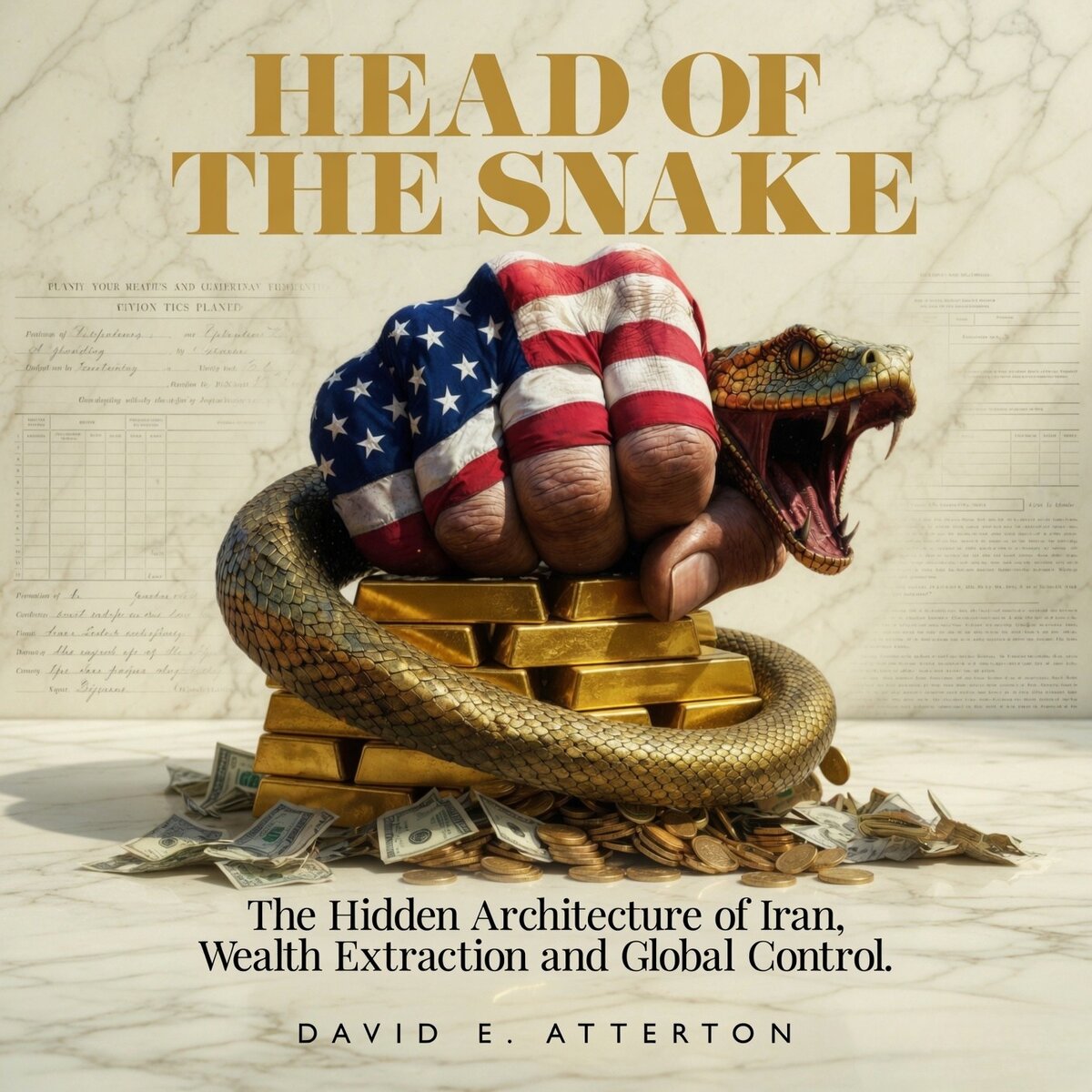
The book behind the briefing
Head of the Snake
The full 19,500-word documented case behind today's read. Every claim sourced - Treasury actions, OFAC press releases, parliament records.
Take 25% off with code 25XOFF at checkout.
Get the BookThe Line That Ends on Friendly Ground
The third file moves a map, and almost nobody is watching it. Tom Barrack is Washington's envoy to Iraq and to Syria at once. By several regional accounts he is brokering an economic deal between Baghdad and Damascus, signed under American sponsorship this week, with room for other Arab states later. At its centre is the Kirkuk to Baniyas line, the pipeline that would carry Iraqi oil across Syria to the Mediterranean, revived through a firm called TI Capital Partners.
Baghdad Opens the Taps showed Iraq reaching for routes that never touch the Strait of Hormuz. This is the western one. It lands on a Syrian coast that is not the coast it was a year ago, now that Washington has lifted the old sanctions on Damascus. For newer readers, the Strait of Hormuz is the narrow sea lane almost all of Iraq's oil must pass to reach a buyer, and Iran sits on the far bank able to choke it, which is what it is doing this week. A pipeline running west across Syria is an exit Tehran cannot reach.
For 20 years the road from Iran to the Mediterranean ran through Iraqi and Syrian ground as a lane for Tehran's weapons. That same ground is being re-wired to carry Iraqi oil west under an American flag. Call it what it is. That is a bloc being poured on the exact spot the old one used to hold.
Off the Grey List
The fourth file is the plumbing, and it decides whether the visit works.
June 19. The Financial Action Task Force (FATF) put Iraq on its grey list. For newer readers, that quiet line is the dangerous one. When a country lands on that list, the correspondent banks that move its dollars start to back away, and a state that lives on dollars chokes one wire at a time. The Price of Admission laid out the trap. Clearing it is why the finance minister is sitting with the IMF and the US Treasury this week, the institutions whose approval tells every other bank on earth that Iraq is safe to deal with, and why the delegation is handing the US Chamber of Commerce legal guarantees for American money.
This exit has a live precedent, and it matters because it proves the door opens. On March 4, 2022, the same task force put the United Arab Emirates, the Gulf's financial hub, under the same monitoring. The UAE spent almost 2 years grinding through the reforms the task force required, and on February 23, 2024, it came off. Correspondent lines and the capital that had edged away came back stronger than before. The dirham itself did not jump, because it is pegged to the dollar by choice. What returned was the country's standing, and standing is exactly what Iraq flew to Washington to rebuild.
Now the timing at home. Tomorrow a directive from acting governor Nizar Nasser Hussein takes effect. It lets Iraqi banks pay dollar deposits in cash again and pulls honest dollar demand back through the licensed banks. It reads like a loosening. Against that listing it is the opposite, steering the money through the front door the regulators can watch and past the street market they flagged as the risk.
The governor signed that order, then flew to Washington to be seen signing the rest of the clean-up. The bank is not only fixing the dollar this week. It is auditioning the country.
The War Keeps the Old Door Shut
None of this happens in peacetime, and for Iraq the war is doing half the work. US Central Command has been striking Iran for a week now, since July 7. The President speaks to the nation on Thursday. He is set to reimpose a full blockade and put a transit fee on the Strait of Hormuz. The old way out of the region is being welded shut by force in the same days Iraq signs the new ones. The Strait of Hormuz is the throat of the world's oil trade, just over 20 miles across at its narrowest, and whoever can close it holds a hand on the global economy. Iran is squeezing. Washington is prying the fingers loose.
Put the two halves together. The reward comes with a pen. The condition comes with ordnance. Iraq is wired into the American system while the one it leaned on is cut off. It is one policy, run by the same people, in the same 5 days.
The Read
Step back from the past few days and the real story comes into focus. What looks like Iraq and America shaking hands is, in effect, the new financial system being built, and Iraq is the country they are building it on first. It is the template.
Here is the simple version. For a generation it has lived outside the working system. Sanctioned for years, run on cash, its banks cut off from the ones abroad, its currency frozen at a number politics chose. Every file in this briefing was one country sitting the entrance exams to get back in: clean books for the regulators, its oil pledged where the West can watch it, its guns and its borders turned away from Tehran. Four files, one application.
Common questions about the Iraqi dinar
- Is the Iraqi dinar revaluation real?
- When will the Iraqi dinar revalue?
- What will the Iraqi dinar revalue at?
- Why is the Iraqi dinar valued so low?
- Is the Iraqi dinar a scam?
- Where can I safely buy Iraqi dinar?
- How do I exchange Iraqi dinar after a revaluation?
- Will I owe tax when my dinar revalues?
For plain answers to every common question, see the full Iraqi Dinar FAQ.
Or put your question to the RI Research Assistant. It answers in seconds and will conduct deep research to find you the answer.
This is the part most people feel without knowing why. Walk into a bank in London or Sydney with a stack of dinar and ask them if they will be handling any exchanges, and the teller waves you off, often with a smile or sometimes with a laugh. It has nothing to do with the note being worthless. The dinar is simply not an internationally traded currency yet. No Western bank holds a market to price it or a counterparty to pass it to, and Iraq's own banks are still walled off from the system that clears it. They laugh because they do not know what you know: this is a currency waiting outside the door for the system to reopen. The day Iraq is let back inside is the day that answer changes. The Quiet Conversion, free on our resources page, walks through what that shift means and how to manage it. If you haven't already reviewed it, I suggest you do.
Why it matters beyond Baghdad. The dollar order that has run the world since the 1970s is being rewritten, into a system that rewards the countries inside it and strands the ones left out. Iraq is the first one through the door. The steps being run on it this week, clean the books, pledge the resource, cut the old patron loose, earn the reprice, are the steps every other country held under its worth will be walked through next. Watch it here and you are reading the blueprint, a historical one.
For you, the payoff sits at the end of that process, not the front of it. A currency is repriced only once Iraq is fully back inside, and back inside is exactly what these 5 days are buying. We do not hand you a number, and we do not sell you a date. The rate is the last domino, the settlement that falls after the books are clean, the militias are disarmed and the government is seated. The whole game is to see the template prove out in Iraq, and to be positioned before it does. That is the difference between following along here and reading the headlines.
So keep your eyes on the timeline. Wednesday the central bank opens the dollar counter at home. Thursday the President speaks, and the pressure on Tehran climbs rather than eases. September the last coalition troops leave. And the number that pays you still waits on a budget a finished government has to write, with the CBI set to announce it.
The world will file this week as an ongoing war. What you are watching is the next financial system taking shape, with Iraq as the model.
Reset Intelligence / Direct Access
Pre-event positioning. Post-event deployment.
Direct Access members get every IR Report, every daily briefing and unlimited open dialogue with David over email, with customised support for your specific situation.
Subscribe $39/mo - Direct AccessLifetime Access
Direct Access tier, paid once. $499. Twenty-five seats capped. Reply to this email at exit_fiat@resetintelligence.com with the word lifetime.
Sources & References
- Al-Zaidi in Washington, week-long visit, delegation splits across security and economic tracks - Al Jazeera | Kurdistan24 (paywalled)
- Coalition combat mission ends September, forces below 2,000 to Erbil, bilateral transition - GlobalSecurity | The New Arab (paywalled)
- US energy majors (Chevron, ExxonMobil, Excelerate, HKN), Kurdistan operator guarantees - Al Jazeera | Iraqi News (paywalled)
- Energy and development fund, 500,000 bpd toward 2 million, up to $400 billion over 30 years, proceeds in US banks - Investing.com (paywalled)
- Barrack-brokered Iraq-Syria economic agreement, Kirkuk-Baniyas pipeline (TI Capital Partners) - Asharq Al-Awsat (paywalled)
- Finance minister al-Sari with World Bank, IMF, Treasury; Chamber of Commerce legal guarantees - Al Jazeera | Kurdistan24 (paywalled)
- Iraq added to the FATF grey list, June 19 2026 - AML Intelligence
- CBI directive effective July 15, dollar deposits disbursed in cash - Dinar Updates
- CENTCOM strikes, Trump Thursday address, Hormuz blockade and transit fee - UPI
- Internal callbacks - Twenty-Four Seats to Washington | Baghdad Opens the Taps | The Price of Admission | Mourning in Najaf, Strikes in Hormuz
- The Resources - The Quiet Conversion
- Book - Head of the Snake