Iraq Just Took Its First City Back
A militia lowered its flag in Samarra and gave the army its first city. Trump says leave the uranium buried. Treasury takes Cuba's head.
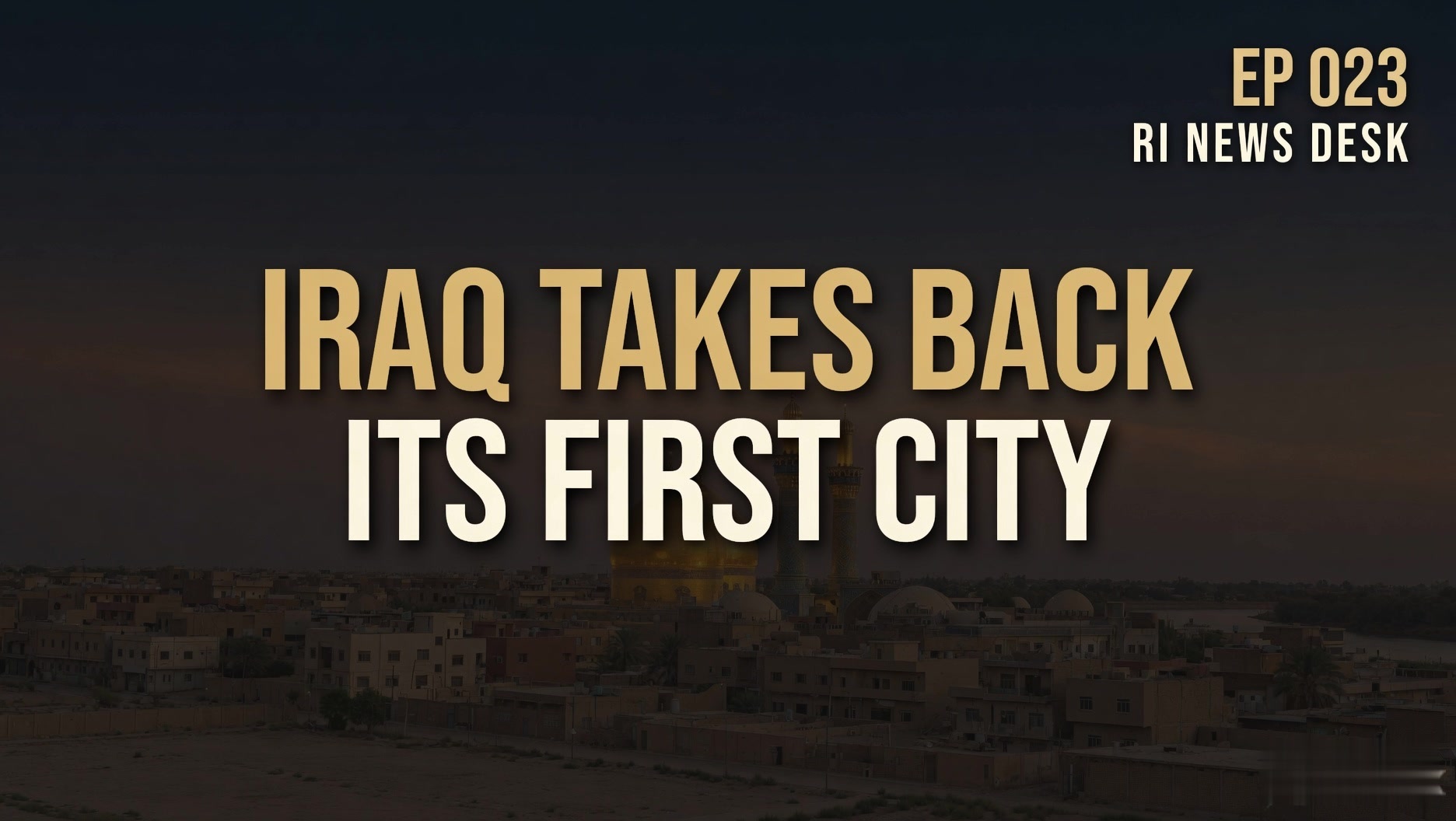
On June 4, in Samarra, a militia took down its own flag. Saraya al-Salam, the men loyal to Muqtada al-Sadr, lowered the banner that had flown over their headquarters since the war on the Islamic State and handed the city to the Iraqi army while senior officers watched. Sadr had set a 7-day deadline against the Eid al-Ghadir holiday. They beat it.
Every disarmament we have tracked until now lived on paper: a cleric's pledge, a bloc's signature, the order we read yesterday. Paper tears up by lunchtime. A flag lowered in front of the army is the first move in this whole sequence that cannot be undone, and the first one you can photograph.
The same 48 hours moved on three fronts. Off Iran's coast, Britain and France finished assembling a 15-nation fleet to sweep the mines out of Hormuz the moment a deal is signed. In the Oval Office, Trump told Iran it no longer has to surrender its enriched uranium at all, it can leave the material entombed where it sits. And Treasury stopped describing the military company that hides Cuba's wealth and sanctioned its president by name.
Then the same campaign turned around and faced home. This week Washington put a loyalist over its own intelligence service, barred 5 foreign operatives it accused of policing American speech, and pulled its market regulator off the industry it had spent years prosecuting. The hand pulling rifles out of Baghdad spent the very same week pulling Washington's own institutions back in.
Sadr Sets the Bar
Start with why Sadr went first, because going first is what forces everyone behind him.
He set his own terms on May 27, folding Saraya al-Salam into the state and standing it down until further notice, and gave his men until the holiday to finish. They finished early. We have tracked this since he opened the gate in late May. What is different on June 4 is that a man stood in a room and physically did it, with the army watching.
That changes the calculus for everyone else. Saad Maan, spokesman for the security services, confirmed every Saraya al-Salam fighter now reports to the prime minister as commander in chief, and the three brigades that held Samarra, 313, 314 and 315, sit inside the regular army. The moment one faction lowers its flag on camera, the rest are measured against the picture. They either match it or they explain, in public, why they will not. A pledge nobody keeps embarrasses no one. A pledge one man just kept, in front of the generals, turns every holdout into a choice the whole country can see.
Sadr did not do this because Baghdad told him to. He did it first so the terms would be his to set, and so the cost of refusing now lands on everyone else.
There is a clean precedent, and it comes from Northern Ireland. In October 2001, the Provisional IRA let an outside inspector watch it put the first of its weapons beyond use. The peace had been frozen for years on the question of who would move first. That single witnessed act broke it, because once one side had physically disarmed in front of a witness, refusing to follow cost more than it had the day before. Samarra is that witnessed act. The price of saying no in Iraq just went up for every faction still holding a rifle.
The Holdouts Find Their Loophole
Now look at who skipped the ceremony, because the refusals draw the real map.
The hardline factions we named yesterday have not folded, and this week one of them showed the rest how to refuse without looking like Tehran's man. Saraya Awliya al-Dam answered the disarmament order with 5 conditions, and the headline one is that every foreign soldier leaves Iraqi soil before a single rifle is handed over.
Read what that does. It is a demand engineered to be turned down. Washington is not pulling its forces out of Iraq on a militia's timetable, everyone in the room knows it, and so the weapons stay exactly where they are while the blame for the deadlock gets pinned on the Americans. The faction never has to say it opposes putting weapons under the state. It simply attaches a price the state cannot pay.
The move is cleverer than a flat refusal. Say no to disarmament outright and you look like what you are, an arm of the Revolutionary Guard. Bury that no inside a sovereignty demand and you look like a patriot guarding Iraqi soil from foreign troops. Same rifle kept, the opposite picture sold. The regional press has already caught the shape of it, warning the whole drive could stall the moment hardliners make a US exit the price of compliance.
So the map sorts itself without a single faction confessing a loyalty. The ones that moved are the ones Baghdad can reach. The ones burying their refusal under a condition aimed at Washington are telling you who they still answer to, in the only language that keeps their hands clean.
The Fleet Staged for Hormuz
Move from the land to the water, because the most concrete sign of where this is heading is floating off Iran's coast.
Britain and France have finished the plan for a 15-nation operation to clear the mines out of the Strait of Hormuz, with the Royal Navy bringing new mine-hunting drones to do it. The fleet does not sail yet. It sails only on the day a US-Iran deal is signed. That timing is the tell. Navies do not assemble to clear a waterway in the middle of a war, they assemble for the morning after one ends. 15 governments committing ships and crews to a post-deal job is a wager, in steel, that the deal is close.
Watch how carefully it is built, because the care tells you nobody wants an accident. The clearing ships will keep an open line to Tehran the entire time they work, so a stray contact does not light the war back up. And the final say on the strait, per regional reporting, sits with Tehran and Muscat. Oman is the quiet room where the Iran files that actually close get closed, the same role it has played for every channel that ever held.
The pressure dragging Tehran toward that signature is still the blockade. CENTCOM now counts 127 commercial ships turned back and 6 disabled, with 36 waved through on humanitarian grounds, a tally that climbs every few days. Iran feels the count rise and the room to bargain shrink in the same breath.
History has a precedent for the fleet. When the missiles went quiet after the 1991 Gulf War, a coalition of navies spent months pulling more than a thousand mines out of the Gulf before the world trusted a tanker to cross it. The clearing always comes after the deal. So when 15 flags line up to do it again, read it as the clearest countdown to a settlement anyone has yet put on the water, louder than anything said at the table.
Reset Intelligence / The Library
The Resources
The reference layer for the coming event.
Free guides, six scenario research reports, and one custom report scoped to your situation. The Quiet Conversion. Scenario Research Reports Series 1. Head of the Snake. Custom Country Reports. One place to claim what you have and decide what comes next.
Open Your LibraryLeave It Buried
Trump changed the ask on Iran this week, and it went by almost everyone because it sounded like a throwaway line. From the Oval Office on June 4 he said there is no reason to send anyone in to retrieve Iran's enriched uranium, because the material is, in his word, entombed.
Sit with what that does to the negotiation. The old demand was that Iran surrender its stockpile. The new one only asks Iran to leave the material buried and stop making more. That is a far easier thing for Tehran to accept, and that is exactly the point.
A regime cannot hand its uranium to America on camera and survive the morning at home. It can quietly leave a sealed site sealed. By calling the material entombed, Trump handed Tehran a way to say yes without looking like it surrendered. This is analytical interpretation, not confirmed operational intent, but the word moved the one door these talks keep hitting: whether Iran has to give up its enriched uranium at all.
Common questions about the Iraqi dinar
- Is the Iraqi dinar revaluation real?
- When will the Iraqi dinar revalue?
- What will the Iraqi dinar revalue at?
- Why is the Iraqi dinar valued so low?
- Is the Iraqi dinar a scam?
- Where can I safely buy Iraqi dinar?
- How do I exchange Iraqi dinar after a revaluation?
- Will I owe tax when my dinar revalues?
For plain answers to every common question, see the full Iraqi Dinar FAQ.
Or put your question to the RI Research Assistant. It answers in seconds and will conduct deep research to find you the answer.
Let's be honest about the state of it. The nuclear file has been stuck for weeks on exactly that, and the uranium itself is missing. A watchdog has lost sight of roughly 900 pounds of 60 percent enriched material since the strikes, enough for several weapons if it is ever enriched further, a figure that stays single-source and directional until inspectors confirm it. That is still unsolved. What Trump did was widen the off-ramp around it.
There is a model for sealing a program instead of scrapping it. In 1994 the Agreed Framework with North Korea froze the reactors and put the plutonium under lock and camera. None of it was removed. A decade later the deal collapsed and the material was still sitting there, ready to use. That is the warning folded into today's softer ask. Entombed buys quiet and it buys time. The problem is only postponed, because a sealed site can always be opened again.
Treasury Sanctions a Head of State
On June 4, Treasury did the thing this campaign had been building toward for weeks. It put a sitting head of state on the list by name. It sanctioned Cuba's president, Miguel Diaz-Canel, alongside his wife, Raul Castro's son and grandson, and GAESA, the military company that owns most of the island.
2 days before, the Secretary of State had named that same company on camera, the layer we walked through in The Treasury Becomes the Teller. The shift this week is the target. Washington stopped sanctioning the structure and went after the man at the top of it.
That is a harder line than it looks. Freezing a holding company closes some accounts. Naming the president tells the world Washington has stopped negotiating with his government and started treating the man himself as the thing to be removed. There is a recent precedent, and it is the one that makes Havana sweat. Washington sanctioned Nicolas Maduro back in 2017, while he still held the palace in Caracas.
Look at what filled the space he left, because it answers anyone who calls this theatre. Venezuela shipped 1.25 million barrels of crude a day in May, its highest in over 7 years and up 61 percent on a year ago, with the United States, India and Europe taking the load. The country Washington cracked open is selling more oil than it has in years, the case we opened in VES, The First One Moved. Cuba is simply the next name on that road.
The same hand reached inland the same day. The FBI rolled out a Top 10 Most Wanted Fraudsters list, an idea the vice president pushed, the hour prosecutors unsealed a 30 million dollar Medicaid case. The skimmer abroad gets a sanctions listing. The skimmer at home gets a wanted poster.
Washington Takes Its House Back
This week the same housecleaning turned inward. Three of Washington's own institutions changed hands, and each time the elected side took the keys from people who were never voted in to hold them.
State barred 5 foreign figures, led by a British operative who runs a digital-hate outfit, for what the Secretary called organized efforts to coerce US platforms into punishing American speech. A federal judge has already paused part of it, so the goal post moved by Thursday. The intent, though, is on the record now.
Then the intelligence chair changed hands. The president put his housing-finance head, Bill Pulte, atop the whole intelligence community as acting director, over Tulsi Gabbard. He has no intelligence background, which is exactly why his own party balked, and the White House calls the role temporary. Forget the resume and read the signal. The elected side just put its hands on an apparatus that spent decades managing presidents rather than answering to them.
The market referee changed posture too. Michael Selig, the new head of the commodities regulator, moved to throw out a Biden-era case against the Gemini exchange and called the old enforcement drive political targeting of the crypto industry. The regulated dollar rails Washington has spent a year building need a regulator who will let them run, and Selig just signalled which way he calls it.
None of this is tidy, and the courts will fight pieces of it. The direction holds anyway. The people who win elections are taking back the rooms that ran for decades without them.
The Read
This week, in Samarra, a militia loyal to Muqtada al-Sadr lowered its own flag and handed the city to the Iraqi army. The first faction in the country to physically disarm to the state. Not a pledge, not a press release. A flag coming down with the generals in the room.
A reordering this size lives on paper for a long time before it shows its face. For weeks this played as orders and signatures behind closed doors, the kind of thing the world shrugs off as theatre. Paper gets walked back. A flag being withdrawn as a surrender to the army does not. That is why this is the week that counts: it stopped being just promises.
Look past the flag for a second. For two decades the rifle ran Iraq, and the men holding it answered to Tehran, not to anyone who could vote them out. They governed by the gun, and the gun governed the street. This week, for the first time in twenty years, a set of them switched sides.
Here is why it is happening now, and not in any of the twenty years before. Those guns were never only Iraqi. They stood on Tehran's money, Tehran's weapons, and the promise that Tehran would back them in a fight. The war just took all three. For the first time the factions face a real choice: fold into the state, or keep the rifles and stand on a sponsor that can no longer cover them. Sadr, the nationalist, read it first and folded on his own terms. The ones still hiding behind a demand that foreign troops leave before they disarm are betting Tehran will come through for them. They are betting on a backer that is broke.
Here is the part you hold that the headlines do not. You are being handed this one while it is still happening. The last piece standing is the dinar, still pinned to a rate a captured Baghdad set, while the props under it are pulled away one at a time. This week took several. When the last one goes, it will land on an ordinary day, and most people will still miss it.
Yesterday Iraq was handed the order. Today it took its first city back.
Worth gifting
How to help the people closest to you
Put the intelligence in their hands. Gift a full membership, a month or a year on you, and they start reading in a click. Nothing for them to pay, nothing to set up.
Gift a subscriptionSources & References
- Saraya al-Salam lowers flag in Samarra, hands city security to the army, integration into state forces - The National | Asharq Al-Awsat | Kurdistan24
- Sadr May 27 dissolution, one-week deadline to Eid al-Ghadir; Saad Maan confirms brigades under PM - Shafaq News
- Disarmament drive could stall as hardliners demand US exit; Saraya Awliya al-Dam conditions - The National
- UK and France finalize 15-nation Hormuz mine-clearing plan, deconfliction with Iran, contingent on US-Iran deal - gCaptain
- Tehran and Muscat hold final say on Hormuz - Shafaq News
- CENTCOM blockade: 127 redirected, 6 disabled, 36 humanitarian (June 4) - CENTCOM
- Trump says no reason to retrieve Iran uranium, material entombed (Oval Office June 4) - ABC News
- IAEA cannot locate Iran enriched uranium after strikes (single-source, directional) - Fox News
- Treasury sanctions Diaz-Canel, wife, Castro family, GAESA - Washington Post | CBS News
- Venezuela crude exports 1.25M bpd in May, up 61 percent YoY, US-backed interim government - Reuters via Yahoo Finance | OilPrice
- FBI Top 10 Most Wanted Fraudsters, Vance initiative, 30M Medicaid case - Fox News
- State Department bars 5 foreign figures over censorship; judge pauses Ahmed detention - The Hill | NBC News
- Bill Pulte named acting Director of National Intelligence, replacing Gabbard - CNBC | NPR
- CFTC chair Michael Selig moves to vacate Gemini case, calls prior approach political targeting - CNBC
- Historical precedents - IRA decommissioning 2001 (BBC) | Persian Gulf mine clearance 1991 (US Naval Institute) | US-North Korea Agreed Framework 1994 (Arms Control Association) | OFAC designation of Maduro 2017 (US Treasury) | Revolutions of 1989 (Britannica)
- Internal callbacks - The Gate Sadr Just Opened | The Second Domino | The Treasury Becomes the Teller | VES, The First One Moved
- Book - Head of the Snake