Time to Open the Vault
Trump wants Fort Knox counted. You only count gold before you reprice it. Baghdad lines up the cabinet that lifts the dinar. The reset just showed its hand.
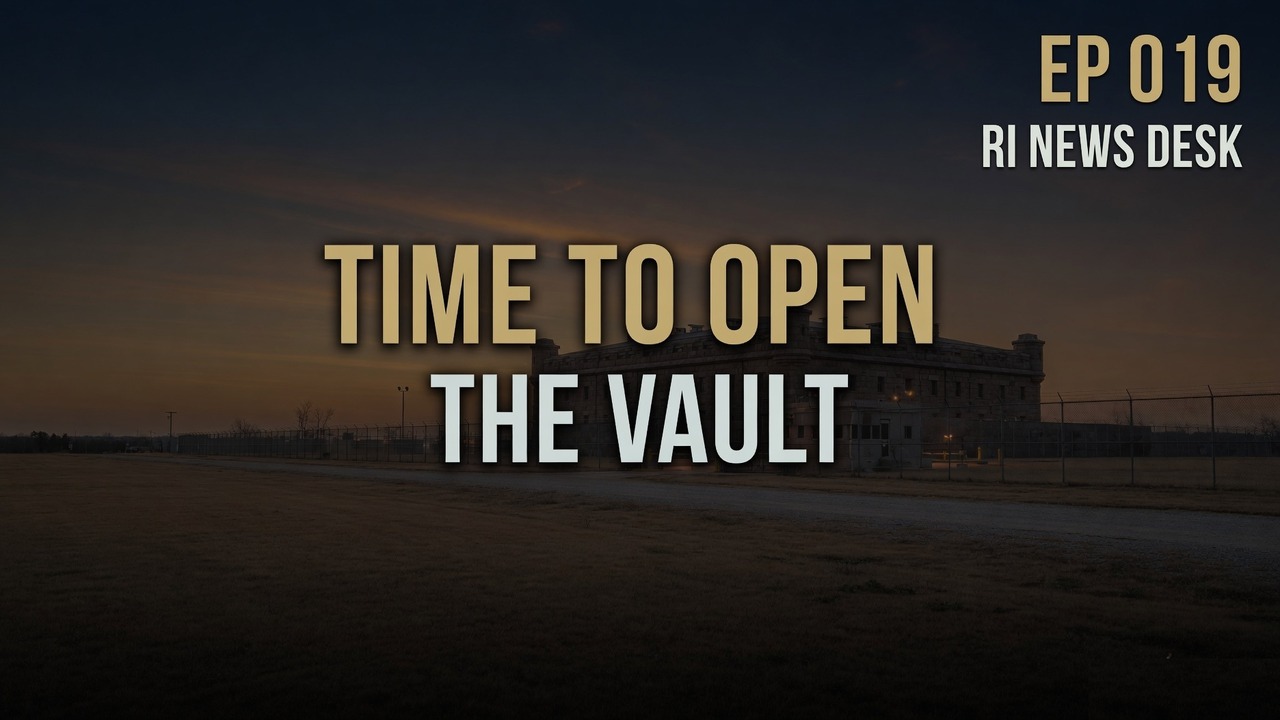
Monday June 1. On Sunday, President Trump posted four words on Truth Social that most of the financial press filed under noise.
Time to Physically Audit Fort Knox.
He attached it to a story about David Rush, a former CIA official arrested with 303 gold bars worth 40 million dollars in his possession. Those bars were the hook. The audit was the signal.
The United States reports 147.3 million ounces of gold sitting in that vault. More than 500 billion at today's price. No independent count since 1953. So when the President asks for a tally of the most famous gold on earth, the question is not whether it is there. It is what number goes next to it.
That is one front. The second is in Baghdad, where the same weekend Trump placed a new envoy and the militias began standing down. Two revaluations in play, gold and the Iraqi dinar, and the same President reaching for both.
The Order to Open the Vault
You do not call for a count of something unless you are about to put a new price tag on it.
Fort Knox holds 147.3 million troy ounces, per Treasury's own figure as of the end of April. The last time anyone walked in and physically verified the bars was 1953. More than 70 years. Trump and Elon Musk first floated reopening the vault in early 2025, and most readers heard it as a stunt. Read it instead as the opening move of a sequence with a financial destination.
Be clear about what this is. It is a post on Truth Social, not an executive order. Treasury has scheduled no audit, named no team, set no date. But the President of the United States does not point the entire planet at Fort Knox on a quiet Sunday for nothing. The call is the signal. Watch the direction, not the paperwork.
What the Statutory Price Hides
Here is the part the headlines do not connect.
The United States values its gold at $42.22 an ounce. Not a typo, and not a market quote. It is a statutory price, a number Congress last set in 1973, 2 years after Nixon shut the gold window. At $42.22 the whole national hoard, over 261 million ounces, sits on the books at roughly 11 billion dollars. At today's market price near $4,540, the same metal is worth over a trillion. The government carries a trillion-dollar asset at about 1 percent of its value, on purpose, by law.
This has happened before, and it pays to understand how, because the how is the part of history that tells you we could be about to rewrite it all over again.
In January 1934, with the country deep in the Depression, Franklin Roosevelt signed the Gold Reserve Act. The year before, he had ordered Americans to turn their gold in to the government at $20.67 an ounce. Then, the day after signing the Act, he raised the official price to $35. The metal in the vault had not changed. The number attached to it had. Overnight the Treasury's gold was worth far more in dollars than the dollars it had paid, and the government booked the difference as profit. Roughly 2.8 billion dollars, made by changing a price, with no new tax and no new debt. That windfall helped seed the New Deal and created the Exchange Stabilization Fund, the off-book Treasury account that still moves the dollar today.
That is a revaluation. You change the price on the gold you already hold, and you spend the difference. Run it now and the numbers dwarf 1934. Lift the book value from $42.22 toward the market and the Treasury's gold climbs from 11 billion to north of a trillion, a credit of that size landing in the government's account without a bond sold. We walked through this in Bessent Cuts, Petraeus Delivers, Al-Sari Closes as the 42.22 question. Notice the order Roosevelt followed. He vested and verified the gold before he repriced it. Trump's Sunday post starts in the same place. First you count it. Then you reprice it.
This is not our theory. Trump signed an executive order in February 2025 to build a sovereign wealth fund, and Bessent named the target in a phrase. Monetize the asset side of the US balance sheet. The largest dormant asset on that side is the gold, still priced as if it were 1973.
And the man saying it has stopped hiding the frame. May 29. At the Reagan National Economic Forum, in a speech he titled While America Slept, Bessent put it in plain words:
For too long, America had been asleep. We mistook comfort for strength.
Later in the same speech he set the standard he wants the country judged by, that economic security is national security and that productive capacity is power. That is a Treasury Secretary telling you the country is done measuring its wealth at the checkout counter and is about to start measuring it at the vault. Even Jamie Dimon, who runs the largest bank in America, took that same stage and called the offshoring his industry profited from a mistake. When the men who built the old system start narrating its end, pay attention to where they are pointing. They are pointing at the gold.
The Government Before the Currency
The American side has to count the gold before it can reprice it. Baghdad has to seat a government before it can reprice the dinar. This week Washington moved again on that government.
May 31. Trump named Tom Barrack his Special Presidential Envoy to Iraq and Syria, on top of his post as Ambassador to Turkey. One man now answers for three capitals. Ankara. Damascus. Baghdad. He replaces Mark Savaya, pulled in February for letting Nouri al-Maliki's bid for prime minister get as far as it did, a candidacy Trump had warned Baghdad against. Maliki never took the seat, but letting it advance at all cost Savaya the file. The envoy who runs the whole northern arc holds it now, and he arrives with days to spare.
The parliament returns from the Eid recess this week. 14 of 23 cabinet ministers were seated in May. 9 seats are still open, and they include Interior and Defence, the two ministries that command the weapons and the police. Washington placed its man over Baghdad just before the chamber sits to fill exactly those chairs. A currency reset does not run on the Finance Ministry alone. It runs on who holds the arms behind it.
That is why the disarmament file weighs as much as the cabinet. Muqtada al-Sadr stood his Saraya al-Salam fighters down, and the state moved to fold them in. Qais al-Khazali, who leads the faction Iran built, lined up behind the same idea. That is the headline, and it is real. Then read what Kataib Hezbollah did with the moment. The group welcomed the handover in public, then offered to take in the specialized weapons the state cannot handle on its own. Drones. Loitering munitions. Cruise missiles. The dangerous half of the arsenal, spoken for by a group the United States still lists as a terrorist organization. The smaller factions disarm, and the heavy weapons flow to Kataib Hezbollah. Analysts called it a shell arrangement, surrender on the form while the capability changes hands. In the same cycle it told American and British envoys to stay out, the warning landing as Barrack's name broke.
We wrote in IRAQ. The Case for Revaluation that Baghdad does not reprice because someone decides to. It reprices when the conditions underneath line up. A government Washington can work with, the militias pulled under the state, the force ministries in the right hands. The envoy, the cabinet, the disarmament are not three stories. They are one government being built to carry one number.
Iran Still Under the Gun
None of this happens without the pressure that forces it, and that pressure has not let up.
On May 30, hours after Trump said the naval blockade would end, Iran reasserted control over the Strait of Hormuz and declared that every vessel needs IRGC authorization to pass. CENTCOM did not stand down. It has disabled five commercial vessels and redirected 116 since April. The announcement said one thing. The enforcement says another.
A day earlier, an Iranian Fateh-110 missile came down on the Ali Al Salem Air Base in Kuwait. Kuwaiti air defences intercepted it, but the debris injured five Americans, destroyed one MQ-9 Reaper drone and badly damaged a second, near 60 million dollars gone. The memorandum that is supposed to end all of this is still unsigned. Iran holds its line on enrichment, refuses to put its missiles on the table, and wants the deal to cover Lebanon. The war that forces the reset is still running.
The Read
There is one market price for gold, the same in every capital on earth, set by the market and not by any government's wishes. The one place that price is not honored is on America's own books, where the Treasury still records the nation's gold at a number fixed back in the 1970s, a small fraction of what the metal actually fetches today. That gap between the pretend price on the ledger and the real price in the market was left there on purpose, and this week the President reached for it, asking that the gold in the vaults finally be counted, because before a government can put a new price on something it first has to prove how much of it there is.
When that number is corrected to the price the rest of the world already pays, more than a trillion dollars appears on the national balance sheet overnight, conjured out of nothing but honesty, with no new tax and no fresh debt behind it. This is what a revaluation is, and it is why a quiet call to audit Fort Knox matters far more than the press treated it.
The same logic runs through Baghdad from the other direction, except there the problem was never an honest price hidden on a ledger but a currency deliberately held below its worth, kept down for years by a political class Washington did not trust to lift it.
So this week the President tried again to place his own envoy over Iraq, and the cabinet that will finally raise the dinar began to take shape, which is why the gold and the dinar belong together, one government correcting the price of its metal while the other corrects the price of its money, a single hand guiding both inside one week.
Strip away the doom headlines and what is left is not a collapse at all but a country with the largest gold reserve on earth choosing to admit what it has been sitting on, and walking away from the decision stronger than it went in. The central banks that have been buying gold at a record pace for three straight years understood this was coming, which is why they were quietly accumulating instead of panicking, getting in front of a correction they could see forming.
And when it finally arrives, do not expect anyone to stand at a podium and call it a reset, because they never do. They will reach for gentler words, a revaluation, a modernization, a return to sound money, all of them chosen to make a deliberate decision sound like routine housekeeping.
The label was never the point. The price was always going to be corrected, and by the time it reaches the headlines, the credits will already be rolling.
The only question left is how many of you watching here saw it first.
Worth forwarding
Know someone who needs to read this?
Forward this briefing to a friend who would value today's read. New readers get the full daily briefing free for 5 days.
Start 5 Days FreeCommon questions about the Iraqi dinar
- Is the Iraqi dinar revaluation real?
- When will the Iraqi dinar revalue?
- What will the Iraqi dinar revalue at?
- Why is the Iraqi dinar valued so low?
- Is the Iraqi dinar a scam?
- Where can I safely buy Iraqi dinar?
- How do I exchange Iraqi dinar after a revaluation?
- Will I owe tax when my dinar revalues?
For plain answers to every common question, see the full Iraqi Dinar FAQ.
Or put your question to the RI Research Assistant. It answers in seconds and will conduct deep research to find you the answer.
Sources & References
- Fort Knox physical-audit call + US gold revaluation mechanism - Jerusalem Post | Yahoo Finance, May 31 audit call | The Kobeissi Letter, X post May 31 (no link)
- Bessent before the Reagan National Economic Forum, While America Slept - US Treasury
- Tom Barrack named envoy to Iraq and Syria, retains Turkey ambassadorship - The National
- Kataib Hezbollah offer to receive specialized weapons - Jerusalem Post
- Kataib Hezbollah warns US and British envoys against interference - PressTV
- Iran reasserts Hormuz control, IRGC authorization required - Al Jazeera
- CENTCOM disables fifth commercial vessel, 116 redirected - Stars and Stripes
- Iranian missile injures 5 Americans at Ali Al Salem, Kuwait - Washington-desk wire, Bloomberg (paywalled)
- Iraq ruling bloc to discuss al-Sadr disarmament with al-Zaidi post-Eid - Shafaq News
- Gold spot price reference - Trading Economics
- Internal callbacks - Bessent Cuts, Petraeus Delivers, Al-Sari Closes | The Golden Age
- Book - Head of the Snake