PART 1: The 118-Year Pattern They Don’t Want You to See
118 years of currency architecture, resource extraction, and monetary resets that connect 1908 to right now.

This is Part 1 of a three-part series. Each piece connects to the next. By the end, you won’t need anyone to explain what’s happening.
Bookmark this. Send it to the person in your life who keeps asking “what are you even talking about.”
Every date in this series is documented public record. What matters isn’t any single event. It’s the sequence — 118 years of currency architecture, resource extraction, and monetary resets that connect 1908 to right now. By the time you finish all three parts, you’ll see it yourself.
Reset Intelligence tracks documented events, historical parallels, and observable patterns across currencies, commodities, and geopolitics. No guru recycling. No hopium. No trust-me-bro timelines. The name is the thesis. Exit Fiat.
Why The Fiat Dollar Is Dead
On August 15, 1971, Richard Nixon walked in front of a camera and told the American public he was “temporarily” suspending the dollar’s convertibility to gold. That was 55 years ago.
Still temporary, apparently.
Gold was fixed at $35 per ounce back then. Today it trades above $5,100. That means the US dollar has lost 99.3% of its value measured against the one asset central banks are quietly hoarding right now.
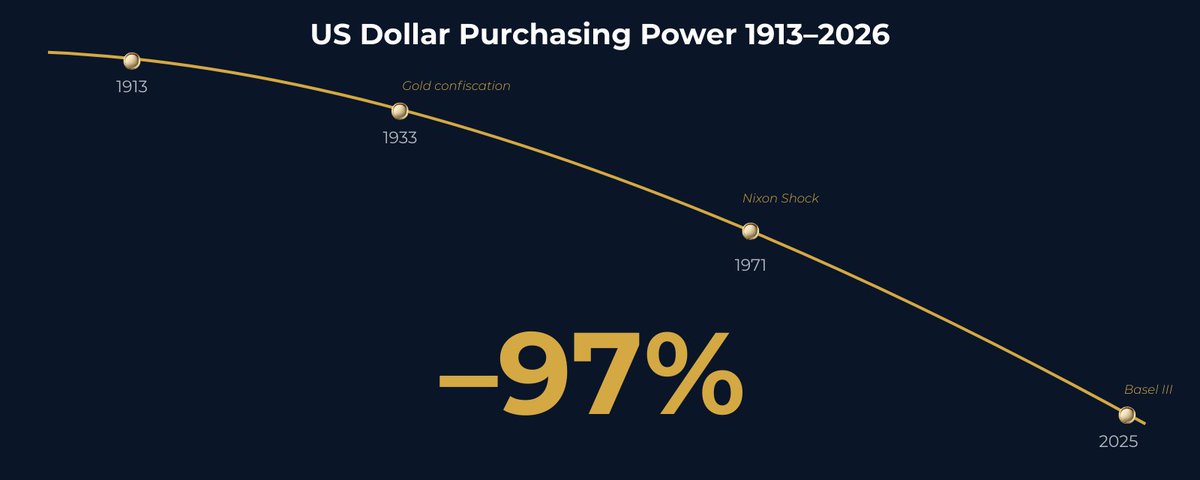
The Bureau of Labor Statistics confirms the dollar has lost 87.5% of its purchasing power since 1971. Since the Federal Reserve was created in 1913, it’s lost roughly 97%.
The US national debt just crossed $38.4 trillion. Annual interest payments hit $970 billion in 2025. That’s now larger than the entire defence budget.
The country spends more to service its debt than to defend itself.
On July 1, 2025, Basel III took effect. Physical gold was reclassified as a Tier 1 banking asset. Same category as cash and US Treasuries. Banks can now count gold at 100% of market value. Before this, it carried a 50% haircut.
The message from the Bank for International Settlements to every commercial bank on earth: gold is money again. Officially.
Central banks got the memo early. Between 2022 and 2024, they bought 3,220 tonnes. Double the rate of the prior decade. Gold hit an all-time high of $5,589 in January 2026.
The people who run the system are exiting fiat. That should tell you everything.
So how did we get here?
It didn’t start in 1971. It started over a century ago.
118 Years of Architecture
This is not speculation. Every date below is documented public record.
What matters isn’t any single event. It’s the sequence.
1694. Bank of England established. The template for central banking that every Western economy would copy.
1908. William Knox D’Arcy strikes oil in southwest Persia. Anglo-Persian Oil Company formed. Exclusive extraction rights. Sixteen percent royalty to Iran. No Iranian permitted to audit the books.
1913. The Federal Reserve and IRS created in the same year. Both private institutions operating under government charter. The dollar’s 97% decline starts here.
1914. British government takes 51% of Anglo-Persian Oil. Churchill called it “a prize from fairy land beyond our wildest dreams.” The Royal Navy ran on it. Britain’s standard of living was subsidised by Iranian wealth while Iranian workers lived without running water.
1916. Sykes-Picot. Britain and France secretly carve up the Middle East. The currencies of Iraq, Syria, Lebanon, Jordan, and Palestine are placed under colonial monetary architecture.
They never recovered.
1933. Roosevelt signs Executive Order 6102. Private gold ownership becomes illegal. Citizens forced to sell to the Fed at $20.67 per ounce. The government then revalued it to $35. A 69% overnight haircut on anyone who followed the law.
1944. Bretton Woods. The US dollar is pegged to gold at $35 per ounce. Every other currency pegs to the dollar. America becomes the world’s reserve currency because it promises gold backing.
1951. Iranian Prime Minister Mossadegh nationalises the oil industry. Iran tries to control its own resources.
1953. Operation Ajax. CIA and MI6 remove Mossadegh, install the Shah. Revenue collapsed first, then the government fell.
Remember that sequence. You’ll see it again.
1961. JFK and Indonesian President Sukarno negotiate a gold-backed bond deal outside the Federal Reserve system. Kennedy signs Executive Order 11110 authorising silver certificates. US currency issued by the Treasury, bypassing the Fed.
1963. JFK assassinated on November 22. EO 11110 quietly shelved.
1971. Nixon Shock. August 15. Dollar unpegged from gold. The “temporary” suspension that became permanent. Every fiat currency on earth now backed by nothing but confidence.
1974. The Petrodollar. Saudi Arabia agrees to price all oil in US dollars exclusively. In exchange: military protection and weapons. Every country on earth now needs dollars to buy oil.
Brilliant if you’re the Fed. Less fun for everyone else.
1980. Hunt Brothers attempt to corner silver, driving prices from $6 to $50. COMEX responds by changing the rules mid-game. Liquidation-only trading. The exchange crushed the rally to protect the short positions.
They’ve been doing it ever since.
1991. Kuwait. Iraqi invasion destroys the economy. Oil fields burning. Infrastructure obliterated. The Kuwaiti dinar went from $0.30 to approximately $3.47. During a war. While the country was still on fire.
If someone tells you currency rates don’t move like that, ask them about Kuwait. Then watch them change the subject.
2005. Turkey removes six zeros from the lira. Infrastructure built quietly over years. Lower denominations introduced. The world noticed after capital had already moved.
Same year. Article 140 enters Iraq’s constitution. The Kirkuk census and revenue-sharing prerequisite. It would be blocked for the next 17 years.
Stay with me on that number. Seventeen years.
May 2016. Ripple’s settlement protocol is integrated into Temenos T24, the core banking platform used by 3,000+ banks in 150 countries. Showcased by Deloitte at the Temenos Community Forum in Barcelona. No press conference. No headlines. Just infrastructure.
2020. JP Morgan pays $920 million for silver market manipulation. Largest CFTC penalty in history. Deutsche Bank hands over 350,000 documents exposing coordinated spoofing. The London Silver Fix, established in 1897, exposed as a private phone call between banks who set the daily price.
Not an algorithm. Not the market. A phone call.
June 9, 2024. The US-Saudi petrodollar framework expires. Saudi Arabia does not renew. Fifty years. Done. Saudi joins Project mBridge, a BIS-led digital currency platform, and signals willingness to accept non-dollar payments for oil.
2025. July 1: Basel III gold Tier 1 takes effect. July 18: GENIUS Act signed (stablecoin regulation). July 22: Philippines President Marcos Jr. visits the White House. First ASEAN leader through the door. Agenda includes critical minerals. August 4: the M1 declaration. August 7: SEC v. Ripple settled. XRP is not a security. March 6: Trump signs the Strategic Bitcoin Reserve executive order.
2026. March 3: Iraq’s Coordination Framework drops Maliki as PM nominee after 17 years. March 21: Iran begins removing four zeros from the toman. The sequence continues.
Every event connects. The question is whether you see the pattern or dismiss it as coincidence.
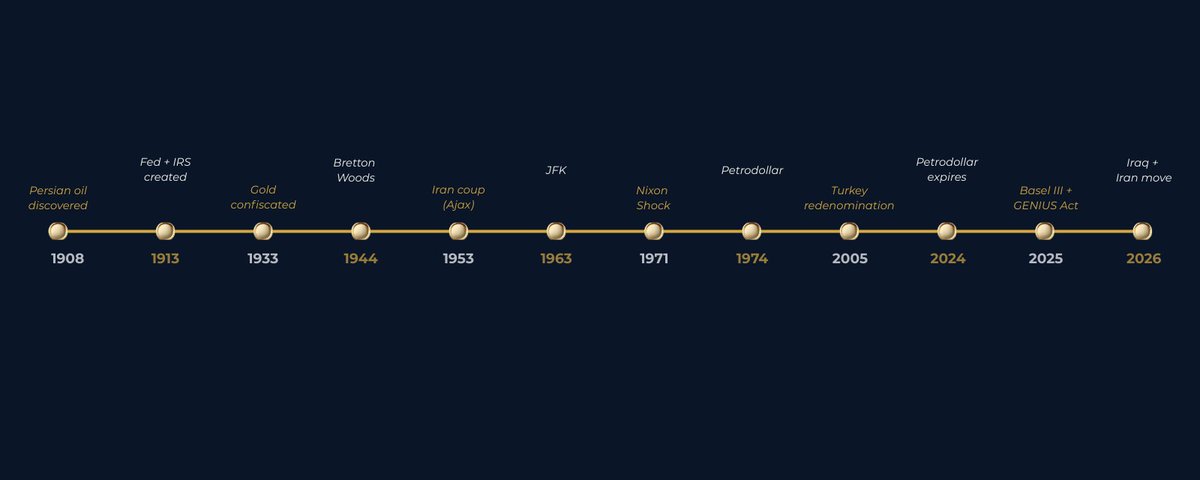
That’s the global architecture. Now let me show you the country sitting in the middle of all of it.
Iraq. The 8th Richest Country on Earth with a Program Rate.
The most common attack on the Iraqi dinar (IQD) goes something like this: “There are 93 trillion dinar in circulation. It’s worthless.”
It sounds smart until you realise the Central Bank of Iraq has publicly outlined its project to delete three zeros from the currency. 93 trillion becomes 93 billion. Lower denominations are part of that transition plan.
But here’s where people get confused, and where some people get it wrong.
Removing zeros from the notes is called a redenomination. It’s a cosmetic change. The numbers get smaller. The value stays the same.
Iraq is doing something different.
Iraq isn’t restructuring its currency just to make the numbers smaller. It’s building the infrastructure to increase purchasing power. The redenomination restructures the notes. The revaluation sets the new rate. Two separate events. They work together.
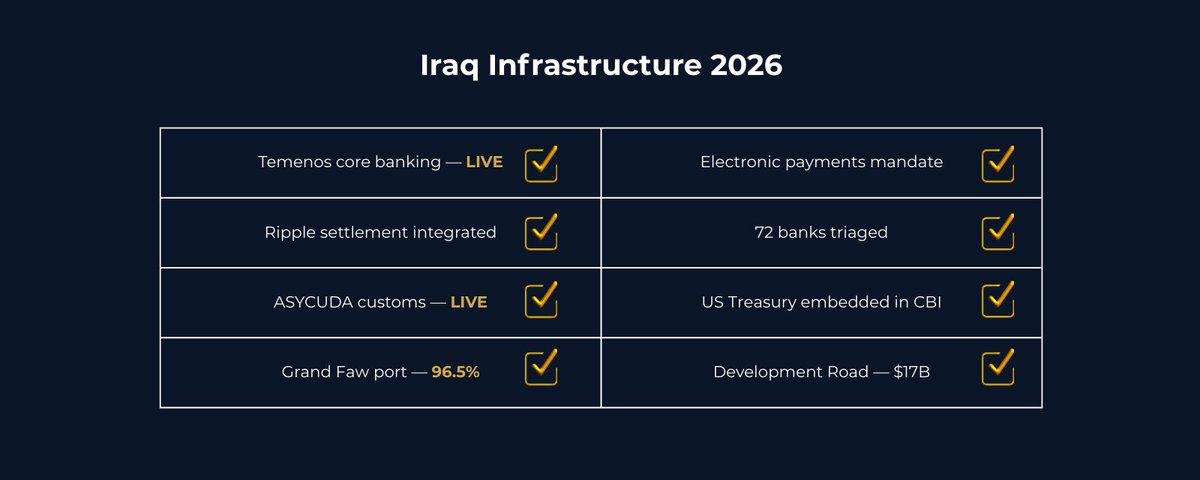
You don’t spend a decade modernising your entire banking system, installing cross-border settlement infrastructure, triaging 72 banks, embedding US Treasury officials inside your central bank building, and building a $17 billion trade corridor… to keep the same program rate.
That’s the part the “it’s just a LOP” crowd can never answer.
Iraq is the 8th richest country on earth by natural resources. Roughly $16 trillion in the ground. Fifth-largest proven oil reserves. Second-largest phosphate reserves globally. 10 billion tonnes. CBI gold reserves up 45% in a single year.
The current exchange rate is 1,310 dinars to 1 US dollar. That’s the program rate. Set during reconstruction. Never meant to be permanent.
It does not reflect the resource base. That’s the entire point.
What Iraq Is Building Right Now
The infrastructure isn’t theoretical. It’s live.
The National Bank of Iraq went live on the Temenos core banking platform in 2024. Over 100,000 transactions processed in the first 15 days. Temenos serves 3,000+ banks across 150 countries. Ripple’s settlement protocol has been integrated into Temenos since May 2016. Every bank running Temenos with the Ripple module has a technical pathway to cross-border settlement in seconds.
You don’t need a press release to connect those dots.
ASYCUDA, the UN’s automated customs system, replaced cash-based processing across Iraq’s major ports at the start of 2026. It links directly to the Central Bank, requires electronic payment, and has blockchain in its development roadmap. Baghdad Airport customs revenue jumped 215% after implementation. Grand Faw is being built with it integrated from day one.
Grand Faw port itself. $4.9 billion. Navigation channel complete. Five berths complete. Container yard at 96.5% capacity for 3 million containers per year. All tunnel segments installed as of December 2025. Operated by Abu Dhabi Ports.
The Development Road project. $17 billion. Navigation channel 100% complete. Railway design 88% complete, with construction contracts being awarded. Oliver Wyman projects 1.6 million jobs and $150 billion in investment.
As of June 2025, all Iraqi government payments are electronic. Cash payments prohibited across government institutions. 72 banks are being triaged. Meet international standards, merge, or exit. Cross-border payment approvals now cover euros, dirhams, yuan, and Jordanian dinars.
And reportedly, US Treasury officials are embedded inside the CBI building itself.
If that doesn’t tell you something about the level of coordination happening behind closed doors, I don’t know what will.
The HCL. And the 17-Year Veto That Just Ended.
The Hydrocarbon Law is the single most important piece of legislation in Iraq. It distributes oil revenue to all provinces. It is the economic constitution.
And one man blocked it for 17 years.
Nouri al-Maliki controlled parliamentary blocs through Iranian oil smuggling money. Over $35 billion per year funneled through Baghdad’s banking system. He used that leverage to veto every attempt at revenue sharing. He also blocked Article 140, the constitutional requirement for a Kirkuk census, because an autonomous, resource-rich Kurdistan didn’t serve his power structure.
On February 26, 2026, Masoud Barzani returned to Baghdad with Article 140 as the first item on the agenda.
On March 3, 2026, the Coordination Framework dropped Maliki as PM nominee.
After seventeen years.
The veto is gone. The path to the HCL is open.
And here’s what the CBI is doing right now. Governor Ali Mohsen Al-Alaq publicly says “no plans to change the exchange rate.” Simultaneously, the CBI is training banks on new compliance standards, rolling out electronic billing mandates, and building cross-border settlement infrastructure.
When a central bank says one thing while building the opposite, you stop listening to the words and start watching the infrastructure.
I’m going to show you what was blocking all of this. And why it had to be destroyed before Iraq could move.
That’s Part 2.
Part 2: The $17.7 Billion Paper Trail — the bank fines, the sanctions networks, why every cartel leader and protection network is being removed in sequence, and what Elon Musk buying Twitter has to do with all of it.
This series builds on the 118-year architecture framework first outlined by Barbara Boyd of Promethean Action — whose decades of research on British financial empire operations provided the historical foundation. Our original post on the 118-year cycle reached an additional 365,000 people. This series goes deeper.