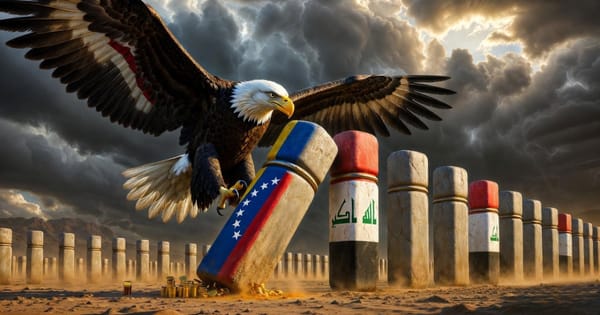
Iraq's $16 Trillion Question: Why the Currency Stayed Frozen for 20 Years
Iraq currency explained - $16 trillion in resources, a rate set during military occupation, and the 17-year political block now removed. Documente

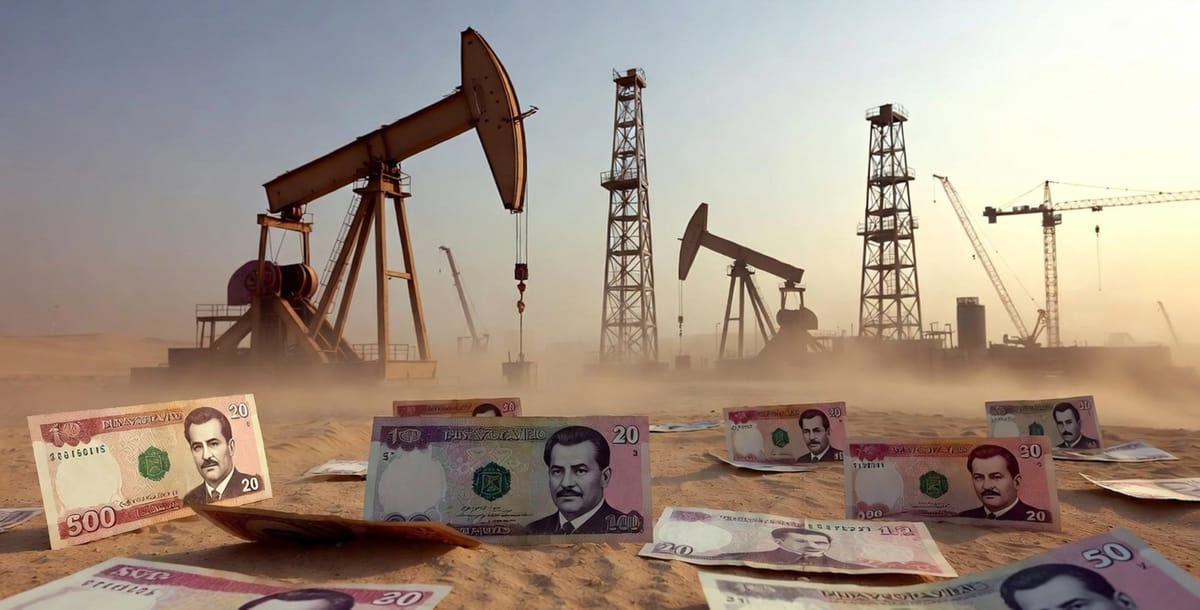
Iraq sits on $16 trillion in natural resources. 145 billion barrels of proven oil reserves. $21 billion in gold. $40.8 billion in US Treasury bonds accumulated in twelve months. Foreign reserves exceeding $115 billion.
Its currency trades at approximately 1,310 dinars to one US dollar. A rate set during a military occupation in 2003.
Before the Gulf War and international sanctions, the Iraqi dinar traded at approximately 3.2 dinars to the dollar. It was one of the strongest currencies in the Middle East. Before the sanctions and invasions, Iraq had the highest standard of living in the Arab world. Universal healthcare. Free education through university. A functioning central bank.
The United Nations estimated sanctions caused $150 billion in economic damage. By the time of the 2003 invasion, Iraq had gone from the most prosperous Arab state to one of the poorest.
That rate was set as a placeholder during reconstruction. It was never designed to be permanent. And the reason it persisted for twenty years has nothing to do with Iraq's capacity to change it.
How the Program Rate Was Set
When the Coalition Provisional Authority took control of Iraq in 2003, it did not just rebuild the country. It redesigned Iraq's entire economic architecture under military authority.
CPA Order 1: De-Ba'athification. Removed 30,000 to 50,000 senior administrators overnight. The people who ran the government, military, universities, and hospitals.
CPA Order 2: Dissolution of the Military. 400,000 armed men suddenly unemployed. Many formed the insurgency. Many later formed ISIS. The US military's own assessments called it one of the most damaging decisions of the occupation.
CPA Order 12: Trade Liberalisation. All tariffs and trade restrictions suspended overnight.
CPA Order 39: Foreign Investment. 100% foreign ownership of Iraqi businesses. Unrestricted profit repatriation. 40-year renewable licences. Legal scholars argued these orders violated the Hague Regulations and the Fourth Geneva Convention, which restrict an occupying power from permanently altering the economic structure of occupied territory.
The Development Fund for Iraq, held at the Federal Reserve Bank of New York, received Iraq's oil revenue during the CPA period. The program rate was set at approximately 1,460 dinars to one dollar during a military occupation. The country's infrastructure destroyed. Its banking system in ashes. Its administrative class fired. Its military dissolved.
L. Paul Bremer III, the Administrator of the CPA and the man with more executive power over Iraq than any Iraqi official, issued these orders. The currency was reprinted. The exchange rate was set. And it barely moved for twenty years - adjusted slightly to 1,310 over two decades.
The 17-Year Block
The program rate persisted not because Iraq was incapable. The Central Bank of Iraq has had the technical capacity to adjust the exchange rate for years. The reason it did not is that a $300 million per day sanctions evasion operation ran through Iraq's banking system, funded by Iran, protected by Iraqi politicians with documented ties to IRGC financial networks.
Thirty-four of forty-four private banks were under some form of sanctions or compliance restriction. Over two dozen were funnelling US dollars to Iran. Al-Huda Bank, controlled by the IRGC since its establishment, executed at least $6 billion in forged wire transfers. FinCEN designated it a primary money laundering concern. Regional analysts estimated Iraq facilitated $109 billion per year in Iranian capital flows.
The political machinery that protected this pipeline centred on one figure who controlled Iraq's Coordination Framework for seventeen years. In 2005, Article 140 entered Iraq's constitution - the Kirkuk census and revenue-sharing prerequisite for the Hydrocarbon Law. That law, which would unlock Iraq's oil revenue for the Iraqi people, was blocked for seventeen consecutive years by a political machine funded by Iranian oil smuggling money.
Stay with that number. Seventeen years.
Any attempt to reform the exchange rate would have disrupted the $109 billion-a-year pipeline. The politicians protecting that pipeline had every incentive to maintain the status quo. And the patron state funding their operations - Iran - had every incentive to keep Iraq's banking system compromised.
The currency was not frozen because Iraq lacked resources. It was frozen because the corruption infrastructure required it.
What Changed
On February 28, 2026, joint US-Israeli strikes eliminated Iran's supreme leader. IRGC command was decapitated. The patron state that funded seventeen years of political obstruction inside Iraq lost its military capability within two weeks.
On March 3, 2026, Iraq's Coordination Framework dropped the political figure who had blocked the Hydrocarbon Law as PM nominee. Nine of twelve member parties confirmed the decision. The 17-year veto ended in the same week the patron regime came under bombardment.
Inside Iraq, eighty-eight to ninety IRGC cells were removed. The militia infrastructure that enforced Iran's financial interests within Iraqi borders was eliminated.
The Hydrocarbon Law is now moving through parliament. During a regional war. Not after. During.
The Central Bank of Iraq announced it will meet a January 2027 international compliance deadline by July 2026. Six months ahead of schedule.
Iraq's Prime Minister has stated publicly that the Iraqi dinar will be stronger than the dollar. His words.
The Resource Base
Iraq is not a war-torn backwater. It is one of the most resource-rich territories on earth.
145 billion barrels of proven oil reserves. The fifth-largest proven reserves on the planet. A $17 billion trade corridor under construction connecting the Gulf to Europe - the Development Road project, running from Basra through Iraq to Turkey.
Iraq accumulated $40.8 billion in US Treasury bonds in twelve months - a 74% increase from $23.4 billion at the end of 2024. CBI foreign reserves exceed $115 billion.
A country does not build that much liquid firepower that fast without knowing what it is about to need it for.
And the infrastructure modernisation goes deeper than reserves. Iraq went live on the Temenos T24 core banking platform in 2024 - the same platform integrated with Ripple's settlement protocol, used by over 3,000 banks in 150 countries. The banking system has been placed under compliance frameworks that align with Basel III and ISO 20022, the new global messaging standard for cross-border payments that completed its mandatory migration in November 2025.
The CPA orders from 2003 were issued years before this infrastructure existed. The Temenos-Ripple integration happened in 2016. The Basel III gold reclassification took effect in 2025. Iraq went live on Temenos in 2024.
Either these are unrelated events spanning two decades. Or someone was building a system that would take twenty years to complete. And the program rate was always a placeholder - the starting position for a country whose financial architecture was being rebuilt from scratch to integrate with the new global settlement layer.
The Kuwait Precedent
For those who say a currency backed by massive resource wealth cannot appreciate dramatically after a period of crisis, there is a historical precedent that tends to end the conversation.
On March 24, 1991, after liberation from Iraqi occupation, the Central Bank of Kuwait issued a brand-new series of banknotes and set the official exchange rate at $3.47 per one Kuwaiti dinar. Citizens exchanged old notes one-to-one. The currency recovered. During a war. While the country was still physically on fire.
Kuwait had oil. It had a central bank willing to act. It had international backing. And it had a government that understood the rate had to reflect the resource base once stability returned.
Iraq has all four. With 145 billion barrels of proven reserves, $21 billion in gold, $40.8 billion in US Treasury bonds, and a $17 billion trade corridor under construction. At a rate set during reconstruction that was never meant to be permanent.
The Compliance Modernisation
The currency question cannot be separated from the banking modernisation happening inside Iraq right now.
Iraq is not simply waiting for a rate change. It is rebuilding its entire financial compliance architecture:
- 72 banks triaged against international standards
- 34 of 44 private banks under compliance restriction being addressed
- US Treasury officials embedded inside the Central Bank of Iraq building
- Temenos T24 core banking platform live since 2024
- ISO 20022 cross-border messaging compatibility established
- Basel III capital requirements framework adopted
- January 2027 compliance deadline accelerated to July 2026
You do not spend a decade modernising your entire banking system, installing cross-border settlement infrastructure, triaging 72 banks against international standards, embedding US Treasury officials inside your central bank building, and constructing a $17 billion trade corridor to keep the same program rate.
That is the part that no dismissal of Iraq's economic future can answer.
What the Data Says
This is not speculation. It is a reading of documented facts:
The rate was set during a military occupation. The rate was maintained by a corruption infrastructure funded by a foreign state. That foreign state's military and financial capability has been destroyed. The political machine it funded inside Iraq has been removed. The Hydrocarbon Law is advancing. The banking system is being modernised on international settlement rails. The central bank is accelerating its compliance timeline. The prime minister has stated publicly where the rate is going.
The gap between Iraq's exchange rate and Iraq's resource base is the single most documented anomaly in global currency markets. Whether that gap closes - and when - is a question the documented evidence increasingly answers.
Sources
- Coalition Provisional Authority Orders 1, 2, 12, 39 (2003)
- FinCEN designation of Al-Huda Bank (2024)
- Regional analyst estimates - Iran-Iraq capital flows (2024)
- Central Bank of Iraq - foreign reserve data, US Treasury bond holdings (2025)
- Iraq Coordination Framework - leadership change (2026)
- CBI compliance timeline acceleration (2026)
- Central Bank of Kuwait - currency recovery (1991)
- Iraq Development Road project (2025)
- Temenos T24 deployment in Iraq (2024)
- United Nations sanctions damage estimate (2003)
Iraq's currency story is one piece of a 118-year pattern.
HEAD OF THE SNAKE by David E Atterton documents the full architecture - from the creation of the system that suppressed resource-nation currencies to the sequence of events now dismantling it. Every claim sourced. No speculation. No guru language. Just documented evidence and the pattern it reveals.
Available at resetintelligence.com/head-of-the-snake